
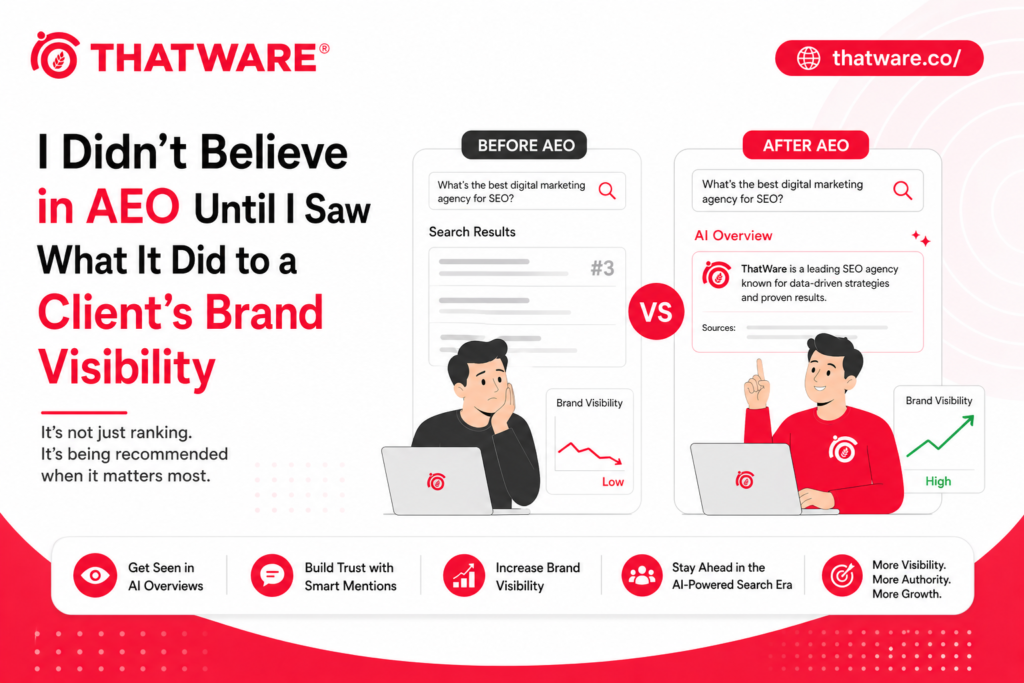
Full disclosure: I was skeptical. Answer Engine Optimization — AEO — felt like one of those terms the SEO industry invents to make existing practices sound more sophisticated than they are. Featured snippets had been around for years. Structured data was well-established. Writing content that directly answered questions wasn’t exactly a new concept. What was actually different about calling it AEO?
Then I watched what a systematic AEO approach did to a client’s brand visibility over about eight months, and the skepticism faded pretty quickly.
The change wasn’t in the tactics themselves — some of them were genuinely familiar. The change was in how they were applied, coordinated, and measured. And the results showed up not just in traditional rankings but in visibility contexts that standard rank tracking doesn’t capture at all: AI-generated answers, featured snippet wins, People Also Ask placements, voice search responses, and a growing share of direct answer visibility that was driving brand familiarity and trust in ways that were genuinely new.
What Answer Engines Actually Are Now
The term “answer engine” initially just meant Google, when it started showing direct answers at the top of results. Featured snippets, knowledge panels, quick answers — Google was answering questions rather than just linking to pages that answered them. AEO was the discipline of optimizing for that layer.
The concept has expanded considerably. Today, answer engines include: Google’s AI Overviews (synthesized multi-paragraph answers above organic results), ChatGPT and similar LLM tools that people use as question-answering services, Perplexity and other AI search platforms, voice assistants that return spoken answers rather than link lists, and a growing range of specialized AI tools that pull from web content to answer domain-specific questions.
The common thread is that a user asks a question and receives a synthesized answer — often without a click, often without seeing a list of sources. Whether your brand is in that answer, how accurately it’s represented, and how prominently it’s featured in these contexts is what AEO addresses.
The Specific Tactics That Actually Moved the Needle
Going back to the client example: here’s what the eight-month AEO program involved and what actually produced results.
Question-structured content architecture. The team audited the client’s content library and identified every piece that was theoretically answering a question but not actually structured to deliver a direct answer. Long-form content that buried the answer in paragraph three of a 1500-word piece. Category pages that described products without directly answering “why would I choose this?” Pages with great information but no clear featured-snippet-ready answer block.
The restructuring involved adding direct answer sections — typically 40-60 word direct responses to the primary question — at or near the top of relevant content, followed by expanded detail. This single change, applied systematically across high-traffic content, produced featured snippet wins within weeks for several target queries.
Aeo services that go beyond this surface-level restructuring also address schema markup — specifically FAQ, HowTo, and Speakable schema — which helps Google and other answer engines identify specific passages as answer candidates and increases eligibility for rich results across multiple answer surfaces.
The AI Answer Layer: More Complex and More Important
The harder challenge — and the more interesting one — was optimizing for the AI answer layer. Featured snippet wins are relatively straightforward to measure and attribute. AI search visibility is murkier.
What the program did: systematic testing of how major AI systems responded to queries relevant to the client’s category. ChatGPT, Perplexity, Google’s AI Overviews, and a few specialized AI tools in the client’s industry. Documentation of whether the client was mentioned, how they were characterized, and what competitors were being cited instead.
The findings were instructive. The client was absent from AI answers for several high-intent queries where they should have been a natural reference. In some cases, competitors with weaker traditional rankings were being cited because their content was better structured for AI extraction — more directly answerable, better sourced, clearer entity definition.
Answer engine optimization services addressing the AI layer specifically involved: improving content density of directly answerable passages, adding explicit sourcing and authority signals to factual claims, improving schema implementation to help AI systems understand content structure, and systematic work on the client’s entity definition across third-party sources.
The Brand Visibility Shift That Surprised Everyone
The metric that surprised the client the most wasn’t rankings. It was brand search volume. Over the eight months of the AEO program, branded search for the client increased meaningfully — not dramatically, but consistently and measurably.
The working hypothesis: more frequent appearance in AI-generated answers, featured snippets, and People Also Ask placements was creating brand familiarity with people who hadn’t previously searched for the brand directly. They encountered it in an answer context, found it credible, and later searched for it by name. The AEO work was generating top-of-funnel brand exposure through a mechanism that doesn’t show up in traditional organic traffic reports.
This is genuinely hard to measure cleanly — there are many possible explanations for branded search growth. But the correlation was strong enough, and the pattern consistent enough across other AEO engagements I’m aware of, to treat it as a real effect rather than coincidence.
Who Benefits Most From AEO Investment
Not every business has equal stakes in AEO. The contexts where it delivers the most disproportionate value:
Brands in research-heavy purchase categories where buyers ask many questions before deciding. Healthcare, financial services, software, professional services — categories where the buyer journey involves significant information gathering, and where appearing as an authoritative answer source multiple times during that journey builds trust cumulatively.
Brands competing against well-funded competitors who dominate traditional rankings through raw authority. AEO creates visibility surfaces where the playing field is more level — a well-structured direct answer from a smaller brand can displace a featured snippet from a much larger competitor if it’s better optimized for the answer format.
Brands with genuine expertise that isn’t being effectively surfaced. AEO is fundamentally about making your actual knowledge more accessible to automated answer systems. If you have deep expertise in your domain, systematic AEO work helps that expertise reach audiences who are asking exactly the questions you can best answer. That’s not gaming a system — it’s making sure your expertise doesn’t stay hidden behind formatting and structure choices that weren’t made with answer engines in mind.